A Stoic practice
Dichotomy of Control
Two columns, for what is up to you and what is not: the division that Epictetus's handbook opens with.
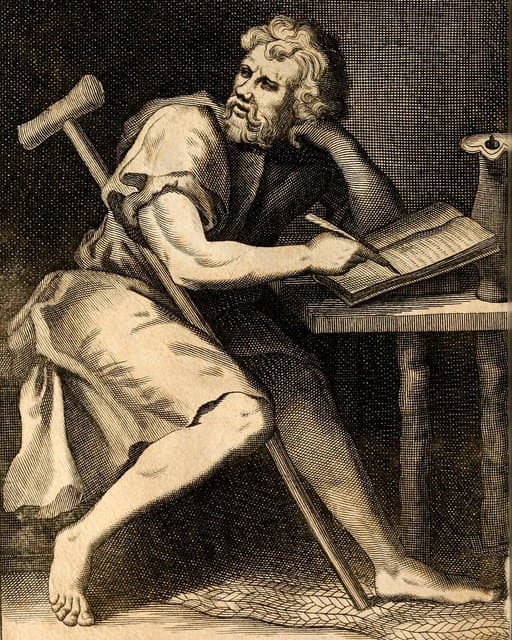

Epictetus
Epictetus was born a slave around the year 50, in Hierapolis, in what is now Turkey. In Rome he belonged to Epaphroditus, a freedman who served the emperor Nero. Once free, he taught philosophy, first in Rome and then, after the emperor Domitian banished philosophers from the city, at Nicopolis in Greece.
He wrote nothing down himself. His student Arrian recorded his lectures as the Discourses, and drew from them a short handbook, the Enchiridion. Its first lines are the whole idea of this module:
Of things some are in our power, and others are not. In our power are opinion (ὑπόληψις), movement towards a thing (ὁρμή), desire, aversion (ἔκκλισις, turning from a thing); and in a word, whatever are our own acts: not in our power are the body, property, reputation, offices (magisterial power), and in a word, whatever are not our own acts.
Epictetus, Enchiridion, chapter 1, translated by George Long (1877)
The name
Dichotomy of control is a modern name, made popular by William B. Irvine's A Guide to the Good Life (2009). Epictetus speaks of what is up to us and what is not, and what is up to us is narrower than control: not even our first reactions are, only what we make of them. That is why the columns on this module say up to me rather than in my control.
Why it helps
The point is not to stop caring about what is out of your hands. It is to put your effort where it can change something. The same chapter ends with a test to use on anything that troubles you:
Then examine it by the rules which you possess, and by this first and chiefly, whether it relates to the things which are in our power or to the things which are not in our power: and if it relates to any thing which is not in our power, be ready to say, that it does not concern you.
Epictetus, Enchiridion, chapter 1, translated by George Long (1877)
How the module works
Two columns on the daily page, headed Up to me and Not up to me. When something is on your mind, write it down on the side where it belongs.
Most worries have a part on each side. You cannot decide how an interview goes, but you can decide how well you prepare for it. Split those into both columns, then work from the left one: it is the list of what today can actually do something about.
Sources
Put it in your planner
Start your plannerFind Dichotomy of Control in the module drawer, under Philosophy & faith. Free, and no account needed to try it.