A Stoic practice
Memento Mori
Fifty-two circles, one for each week of the year, filled in as the weeks go by.

Where it comes from
Memento mori is Latin for remember that you must die. The phrase is best known from Christian art, but the thought is older, and the Stoics came back to it often. Marcus Aurelius uses it in the Meditations not to frighten himself, but to get on with being good:
Do not act as if thou wert going to live ten thousand years. Death hangs over thee. While thou livest, while it is in thy power, be good.
Marcus Aurelius, Meditations, Book IV, section 17, translated by George Long (1862)
Seneca's version
Seneca turns the thought into a habit for the end of each day. In a letter on growing old, he suggests going to sleep as if the day had been the last one, quoting a line of Virgil, so that each morning after it is a gift:
...as we go to sleep, let us say, glad and cheerful: “I have lived; I have run the course that fortune gave me.”
If God adds a tomorrow, let us receive it gladly. He is happiest, and the untroubled master of himself, who waits for tomorrow without anxiety. Whoever has said “I have lived” rises every day to a gain.
Seneca, Letters to Lucilius, Letter 12, section 9, translated from the Latin for this page (2026)
How the module works
Fifty-two circles, one for each week of the year, numbered every thirteen weeks so the quarters are easy to find. It goes once, at the front of the book. Fill in a circle as each week ends.
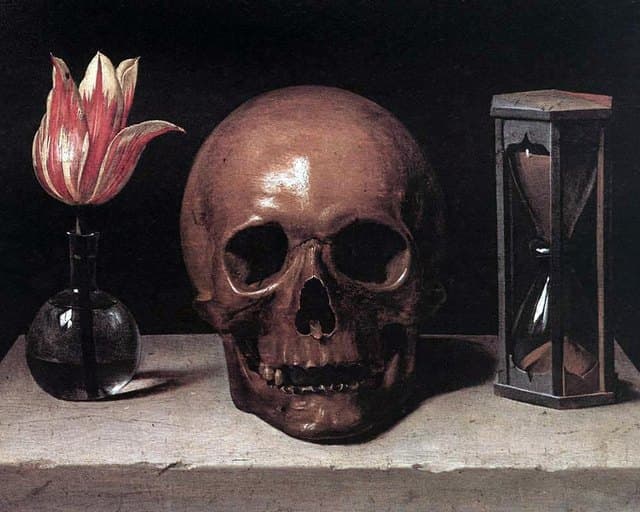
Painters of the 1600s made the same reminder into still lifes called vanitas, like the one by Philippe de Champaigne above: a flower that will fade, a skull, an hourglass running down. The page is meant the same way. The filled circles are time already spent, and the empty ones are the weeks still there to use well.
Sources
- Thoughts of Marcus Aurelius Antoninus, translated by George Long (1862), Book IV, section 17.
- Seneca, Epistulae morales ad Lucilium, Letter 12, in Latin (The Latin Library).
- For the whole letter in English: Richard M. Gummere's translation, Seneca, Epistles, volume 1 (Loeb Classical Library, 1917).
Put it in your planner
Start your plannerFind Memento Mori in the module drawer, under Philosophy & faith. Free, and no account needed to try it.