A Taoist practice
Tao Reflection
Copy out a passage of the Tao Te Ching each day, then write what it says plainly and what it says underneath.

The book
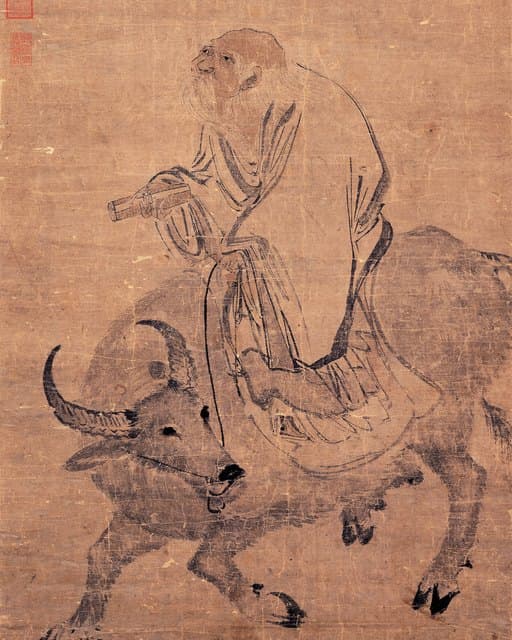
The Tao Te Ching is a short Chinese book of 81 chapters, about five thousand characters in all. Tradition gives it to Laozi, a keeper of the archives at the court of the Zhou kings. The historian Sima Qian tells how it came to be written: leaving for the west, Laozi was stopped at a border pass by its keeper, who asked him to write down his teaching before he went. The painting above shows him on his way.
Scholars think the text grew over time. The oldest copies found, on bamboo slips in a tomb at Guodian, date from about 300 BC.
Its first lines
James Legge, a Scottish missionary who became the first professor of Chinese at Oxford, published his translation in 1891. Many readers now prefer newer translations, but those are still under copyright, and Legge's is free to use, so it is the one quoted here.
The book opens with a play on its key word. Dao means a way or a road, and it can also mean to tell. So the first line can be read as the Tao that can be walked, or the Tao that can be told, is not the lasting Tao. Legge took the road:
The Tao that can be trodden is not the enduring and unchanging Tao. The name that can be named is not the enduring and unchanging name.
Laozi, Tao Te Ching, chapter 1, translated by James Legge (1891)
How the module works
Three prompts with two lines each, on the daily page: The passage, What it says plainly, What it says underneath. Copy the line or two that stays with you, not the whole chapter. Then put it in your own words, and then write what you think it points to.
Many chapters are only a few lines long. At a chapter a day, the whole book takes under three months.
Sources
- The Tao Teh King, translated by James Legge, in The Sacred Books of the East, volume 39 (Oxford, 1891).
- Sima Qian, Records of the Grand Historian, chapter 63, the life of Laozi.
Put it in your planner
Start your plannerFind Tao Reflection in the module drawer, under Philosophy & faith. Free, and no account needed to try it.