A Taoist practice
Wu Wei Reflection
Once a week, write down where you pushed against something, and what yielding would have looked like.

Doing without forcing
Wu wei means, word for word, without doing. In the Tao Te Ching it does not mean doing nothing. It means acting the way things already tend to go, without strain, so that the work gets done without being forced:
The Tao in its regular course does nothing (for the sake of doing it), and so there is nothing which it does not do.
Laozi, Tao Te Ching, chapter 37, translated by James Legge (1891)
Water
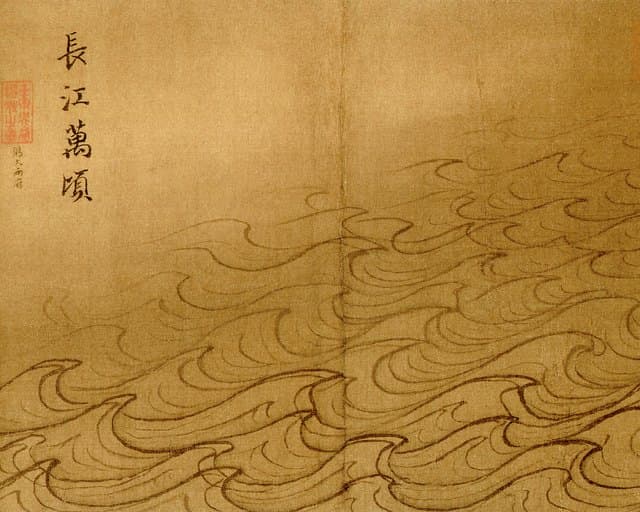
The book's favorite picture of it is water, which gives way to everything and still wears away stone. The painting above is a leaf from the Water Album of Ma Yuan, a court painter of the Southern Song around the year 1200.
There is nothing in the world more soft and weak than water, and yet for attacking things that are firm and strong there is nothing that can take precedence of it...
Every one in the world knows that the soft overcomes the hard, and the weak the strong, but no one is able to carry it out in practice.
Laozi, Tao Te Ching, chapter 78, translated by James Legge (1891)
How the module works
Two prompts with three lines each, on the weekly spread: Where did I force something? What would yielding have looked like? Think back over the week's arguments, deadlines and plans that would not go your way.
Yielding is not giving up. It can mean waiting, asking instead of insisting, or letting a plan change shape. The aim is to notice where effort turned into strain, and to try the other way next time.
Effort itself is not the problem. Quick, hard work can still go with the grain of a situation. What this looks for is force against it.
Sources
Put it in your planner
Start your plannerFind Wu Wei Reflection in the module drawer, under Philosophy & faith. Free, and no account needed to try it.