A Jewish practice
Mussar Trait
Work on one trait of character for a week, such as patience or humility, and mark each day you noticed it, practiced it and thought it over.

Mussar
Mussar is a Jewish tradition of ethical discipline: working on your character, often one trait at a time. A trait is called a middah, and the plural is middot. Mussar books go back to the Middle Ages, and in nineteenth-century Lithuania Rabbi Israel Salanter made the study of them into a movement.
A middah is not a rule to keep. It is a habit of the heart, and the work is to notice it in yourself, practice it on purpose, and look back on how it went.
Lefin's chart
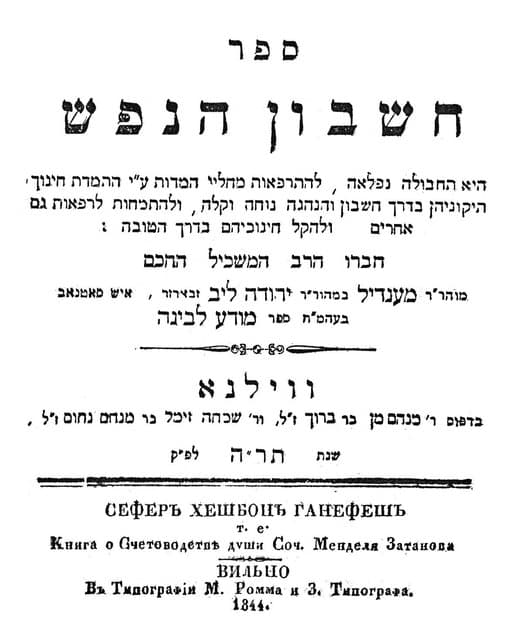
In 1808, Menachem Mendel Lefin, a leader of the Haskalah, the Jewish Enlightenment, published Cheshbon HaNefesh, an accounting of the soul. It works through thirteen traits, one a week, with a chart for marking each day. Lefin adapted the method from Benjamin Franklin's account of his own thirteen virtues, though he did not name Franklin in the book and framed the traits in Jewish terms. Salanter later had the book reprinted in Vilna, in the edition shown above.
The rabbis' old sayings already treat character this way. In Pirkei Avot, Ben Zoma turns four ideas of greatness into traits:
Who is wise? He who learns from all men...
Who is mighty? He who controls his passions...
Who is rich? He who rejoices in his portion...
Who is honored? He who honors others...
Ben Zoma, in Pirkei Avot, chapter 4, translated by Joseph I. Gorfinkle (1913)
How the module works
A week of days across, with three rows to mark: Noticed, Practiced and Reflected. Write the trait in the heading, and mark each day you noticed it in yourself, put it into practice, and looked back on how it went.
Lefin's thirteen include patience, order, humility and silence, but any trait you want to grow will do. Stay with one for a week, or longer if it needs it.
Sources
- Pirke Avot: The Sayings of the Jewish Fathers, translated by Joseph I. Gorfinkle (1913), chapter 4.
- Menachem Mendel Lefin, Cheshbon HaNefesh (Lemberg, 1808; Vilna, 1844).
Put it in your planner
Start your plannerFind Mussar Trait in the module drawer, under Philosophy & faith. Free, and no account needed to try it.